
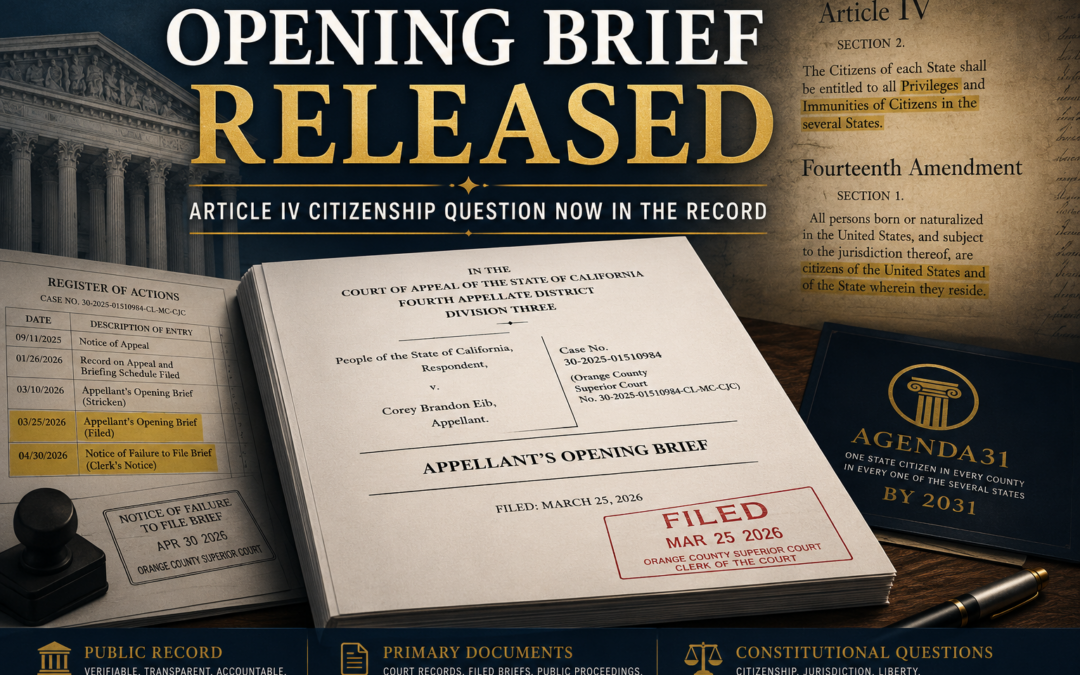

With no response filed, the court may now review the appeal—raising important questions about Article IV and due process.
This is an update on the traffic case and appeal involving Corey Eib in Orange County, California.
The case began on April 11, 2025, when Corey was pulled over in Dana Point and cited for several vehicle code violations, including use of a handheld device and wearing headphones while driving.
At first glance, this appears to be a routine traffic matter. However, from the beginning of the encounter, Corey raised a broader constitutional question that goes beyond a standard Vehicle Code enforcement issue:
Does the California Vehicle Code apply in the same way to someone asserting Article IV state citizenship?
This question forms the foundation of the appeal and introduces a distinction that is rarely addressed in modern courts.
Background of the Case
During the trial, Corey attempted to present evidence and a written declaration explaining his legal position. This included documentation showing that he had formally withdrawn from participation in the DMV licensing system years earlier.
The argument was not simply procedural—it was jurisdictional in nature. The position taken was that the enforcement of certain regulatory schemes depends on legal status, including residency, and that this status must be properly established before enforcement can occur.
Despite this, the court did not accept the submitted evidence.
In addition, a request for a continuance was filed but never ruled on. The case proceeded forward without addressing that request, and Corey was ultimately found guilty and fined approximately $1,400.
Following the conviction, an appeal was filed.
Court Update: Notice of Non-Filing
According to the court’s online system, a Notice of Non-Filing has now been issued to the sheriff.
This means that the responding party did not file a brief within the required timeframe.
A formal copy of this notice is expected to arrive by mail. While the sheriff may still attempt to respond, the procedural window for a timely filing has passed.
If no response is accepted, the court may proceed to review the appeal based solely on the appellant’s brief.
It is important to understand what this does—and does not—mean.
The absence of a response does not guarantee a favorable outcome. The court is still responsible for independently reviewing the legal arguments and determining whether they are valid under the law.
Issues Presented in the Appeal
The appeal raises several constitutional and procedural questions that are not commonly addressed in traffic court proceedings:
- Whether Article IV state citizenship is legally distinct from 14th Amendment “residency”
- Whether a residency-based regulatory system can be applied to someone who has not established that residency
- Whether participation in the DMV licensing system is a prerequisite for enforcement under the Vehicle Code
- Whether due process was violated when evidence was refused and motions were not ruled on
At the center of the appeal is the idea that jurisdiction and legal obligation are not assumed—they must be established.
This creates a threshold question: before enforcing a statute, does the court need to determine the legal status of the individual being charged?
That question is not often litigated in modern courts, which makes cases like this both difficult and important.
Why This Case Matters
Most traffic cases are resolved quickly and without deeper legal analysis. This case is different because it attempts to challenge underlying assumptions about how laws are applied.
Whether one agrees with the argument or not, the case raises a fundamental issue:
To what extent does the government need to establish jurisdiction before enforcing regulatory law?
Questions like this go beyond a single citation. They touch on the structure of constitutional authority and the relationship between the individual and the state.
Because of this, the case may have broader implications depending on how the court addresses the arguments.
Reality of the Appeal
This remains an uphill legal battle.
Even in situations where no opposing brief is filed, courts are not required to rule in favor of the appellant. The burden remains on Corey to present a legally sound and persuasive argument.
Appeals involving constitutional questions are especially challenging. They require precise reasoning, a clear understanding of legal standards, and strict adherence to procedural rules.
Courts tend to rely on established precedent, and when a case raises issues that are not clearly defined in existing case law, the path forward becomes more uncertain.
This is what makes the current appeal both difficult and closely watched.
Supporting the Work
This effort is being funded and carried forward by Corey Eib, Todd McGreevy, and supporters of Agenda31.org.
There is no institutional backing behind this work. No large organization, legal fund, or outside entity is financing the effort.
Cases like this require time, research, filing costs, and sustained attention.
If you believe that these types of constitutional questions are worth raising and defending, there are several ways to support the work:
- Take the time to learn and understand Article IV
- Share this information with others
- Contribute financially to help continue the effort
Support does not require agreement—it begins with understanding.
Every meaningful legal challenge depends on people who are willing to engage with the ideas and follow the process.
Final Note
This update is being shared not just as a case summary, but as an invitation.
Learn the Constitution. Study Article IV. Understand the distinction being argued.
Whether this appeal succeeds or fails, the questions it raises are worth examining.
Further updates will be provided as the appeal process continues.
